Our Approach
Visible Language Pedagogy
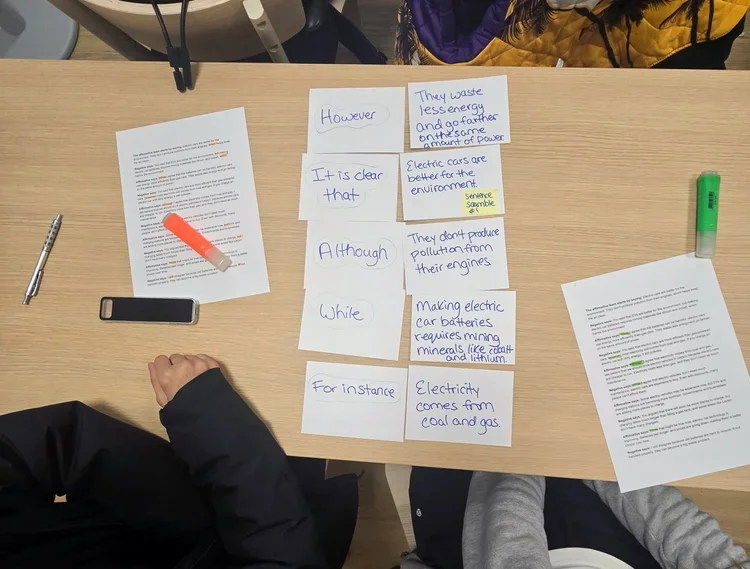
“While” is a tool for navigating tension. “Despite” is a tool for weighing evidence.
Language is the hidden curriculum in every discipline. While students are expected to use academic language to succeed, the mechanics of that language are rarely made explicit.
Standard instruction often focuses on what to say or the rules of grammar. Visible Language™ Pedagogy focuses on how language actually works to build an argument, solve a math problem, or explain a scientific process.
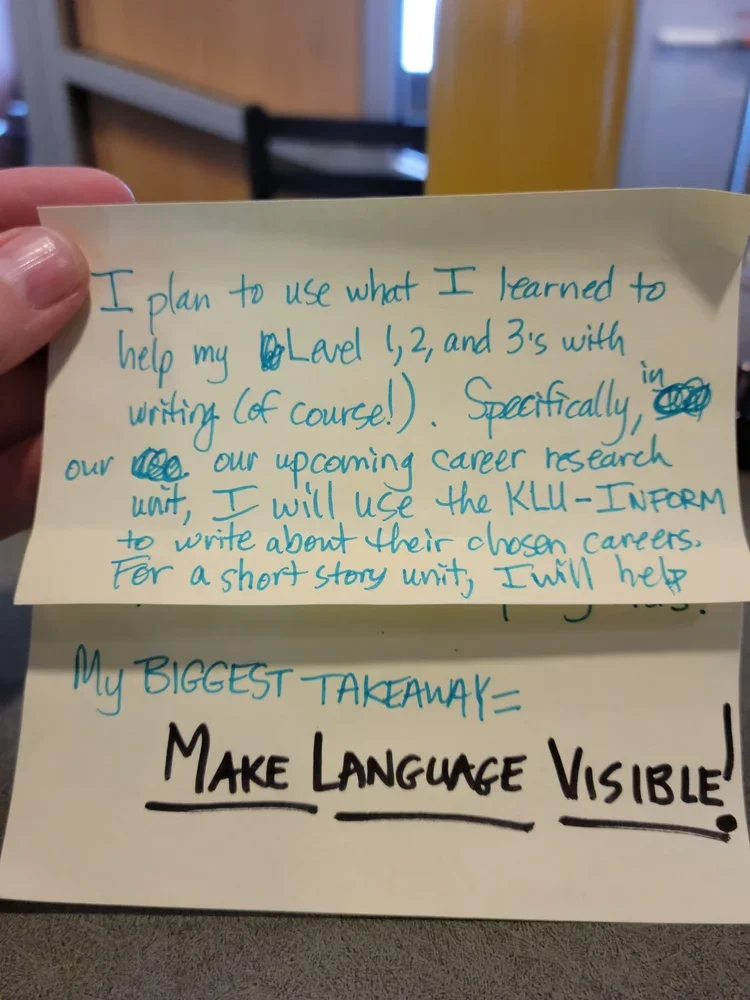
By making these linguistic "codes" visible, we help teachers and students demystify academic rigor. This ensures that every student — especially multilingual and diverse learners—has the tools they need to fully engage with, and excel in, complex content.
[Ruslana video placeholder]
Unpacking Linguistic Codes
The Visible Language Toolkit
Visible Language Pedagogy works because it provides gives teachers and students specific tools and routines they can use to make learning accessible.
-
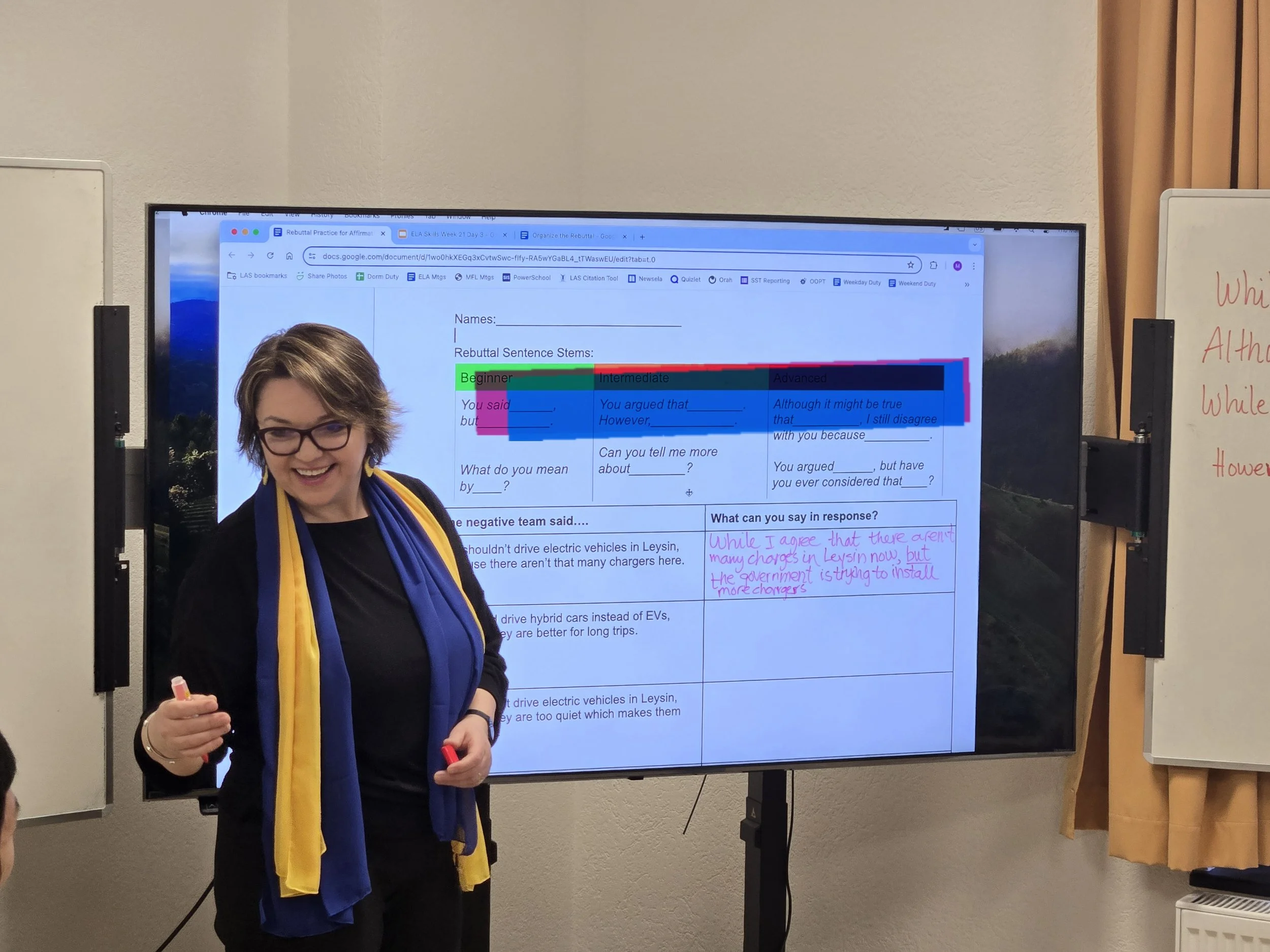
Macro and Micro Scaffolding: Engineer success through unit-level progression and sentence-level linguistic supports.
Disciplinary Genres: Teach the unique language features and “codes” of scientific explanations, historical arguments, and literary analysis.
Teaching and Learning Cycle: Learn a four-stage apprenticeship that moves students from deconstructing mentor texts to independent mastery
-
Joint Construction: Lead co-writing sessions with students, narrating disciplinary linguistic choices in real-time to scaffold their path to independence.
Message Abundancy: Build deep conception knowledge through high-support interaction routines, visuals, and experiential learning.
Structured Interaction Routines: Design oral rehearsal opportunities that let students test drive academic language before they start to write.
The Mode Continuum: Strategically shift students from informal “everyday” talk to authoritative academic writing.
Text Unpacking: Demystify dense academic prose by identifying expanded noun groups, clause relationships, and implicit causality.
-
Metalinguistic Reflection: Turn students into language detectives who can articulate why they choose specific linguistic moves for different disciplines, audiences, and purposes.
Diagnostic “Language First” Assessment: Shift from right/wrong grading to providing feedback that helps students identify exactly where their language is breaking down.
Teacher Story: Visible Language Pedagogy in Practice
Janice is the kind of history teacher students remember. She doesn’t just teach facts and dates. She pushes her kids to debate, challenge sources, and try to defend a position. But for years she hit a recurring wall.
When it came time for students to write an analysis or engage in deep conversation, things fell flat. She got a grocery list of “This happened, then this happened.” She had the content and the high expectations but the specific linguistic moves students need to bridge the two were invisible.

Before and After
Before, Janice prepared for a unit by mapping out the "what"—the key events and the big "why" questions.
Now, she looks at the functional language her students need to actually voice those big ideas.
She used to give an essay prompt and hope some critical thinking would translate to the page.
Now, she helps students identify specific functional verbs historians use to move beyond a timeline. Instead of just asking them to “describe” a cause, she explicitly teaches them how to attribute motives or frame a transition.

The Difference for Students
In a class on the American Revolution, the difference was clear. Usually her students would rattle off facts: “The king passed the Stamp Act, and then the colonists got mad and started a boycott.”
This time, a student who typically struggled to move past the timeline did something different: “The Stamp Act triggered a massive boycott, transforming a tax dispute into a political movement.” He used precise verbs to explain how one event changed the nature of another. He wasn’t just reciting events. He was analyzing a shift in power.
Conceptual work, not just chronological work.
Janice hadn’t thought about her content with this lens before. By making the language of historical analysis visible, she gave her students tools for thinking, talking, and writing like historians.
She didn’t just teach them history. She gave them the tools and agency to participate in it.
Why Visible Language Pedagogy?
For most students, especially for Multilingual Learners, education is a guessing game. Visible Language™ pedagogy takes that guessing out by making knowledge structures, expectations, and disciplinary language and knowledge demands visible through careful pedagogical scaffolding.
Backed by 50+ years of Systemic Functional Linguistics and Genre Pedagogy research, our Visible Language Pedagogy approach bridges the instructional gap from “do research and write, and here is a graphic organizer” to “let’s deconstruct exactly how a scientist uses language to argue a claim.”
Teaching this way is a game-changer because students:
See how language works to build meaning (e.g., how language works in the context of text such as how noun groups, connectors, and clause structures elaborate or connect ideas), rather than guessing or relying on implicit exposure
Gain access to grade-level learning because the language demands of complex texts and tasks are made visible and learnable
Develop control over disciplinary language, moving from spoken-like to more precise, written-like ways of expressing complex thinking
Use language intentionally to inquire, explain, argue, analyze, and create—positioning students as active meaning-makers, not just learners of content
Bottom Line
By making the hidden language and knowledge structures of each discipline explicit, we move beyond fragmented literacy instruction as a set of discrete skills to coherent, integrated disciplinary learning — where reading, writing, speaking, and thinking work together to build knowledge and language simultaneously.
Want to make language visible? Sign up for updates
Sign Up